
3-Tier structure
Every transaction tied to the right client matter — firm-level bank context, matter-level sub-ledgers, and immutable event entries.
Purpose-built for firms that hold and move client funds, with controlled workflows, direct bank connectivity, and records that stay audit-ready.
Patent pending. Concurrency-controlled segmented ledger architecture for fiduciary workflows.
Every transaction tied to the right client matter — firm-level bank context, matter-level sub-ledgers, and immutable event entries.
Trust operations stay aligned with real bank activity for faster matching and cleaner books. No delayed exports.
Bank balance, trust books, and client sub-ledgers checked together to surface variances early — not during month-end cleanup.
Non-destructive record patterns preserve what changed, when, and why — for stronger review and audit readiness.
From solo practices to multi-attorney organizations with high transaction volume.
Precise matter-level ledgering for estate funds, fiduciary disbursements, and beneficiary allocations. Clean attribution and defensible history across long-lived matters where documentation quality matters most.
Streamlined settlement-fund movement with matter-level safeguards. Bank-connected matching for faster close and immutable event trails for partner oversight during high-tempo settlement cycles.
Matter-level segregation and structured workflows for checks, ACH, and transaction verification — so teams can process frequent trust activity under tight timing pressure without losing the control structure.
Standardized trust controls across users, roles, and offices. Repeatable workflows with centralized control logic and cross-role visibility for partners, bookkeepers, and operations managers.
LawLedgers is designed to reduce manual risk, speed trust workflows, and improve confidence in every reconciliation cycle.
Bank-connected matching and structured trust workflows reduce review bottlenecks and manual cross-checking. Continuous matching and reconciliation support before the month-end crunch.
Matter-level validation logic helps prevent over-disbursement and catches balance issues earlier in the cycle. Pre-move validation against matter-level availability and ownership rules.
Immutable entries and clear event trails make it easier to respond to internal controls reviews and external audit requests. Evidence quality built into daily operations, not assembled after a complaint.
Deposits, withdrawals, checks, ACH transfers, and ledger activity in one controlled workflow with complete historical accountability.
Unified handling of deposits, disbursements, checks, ACH, and ledger updates with matter-level validation before funds move. Consistent workflow evidence for oversight, partner review, and compliance response.
Non-destructive void and reversal patterns. Clear event trails for who changed what and when. Defensible event chronology for audits, inquiries, and partner-level review.
Three-way reconciliation workflows aligned to legal trust-accounting expectations. Variance detection with operational context for faster resolution. Retention-oriented reporting for audit-ready records.
| Trust workflow area | Manual / spreadsheet | LawLedgers |
|---|---|---|
| Bank activity alignment | Often delayed. Imports and manual matching. | Bank-connected. Faster matching and cleared-date support. |
| Matter-level disbursement control | Manual checks. Prone to oversight under time pressure. | Validated in software. Against available matter balance before release. |
| Transaction history integrity | Editable rows. Obscure historical accountability. | Immutable patterns. Non-destructive void and reversal behavior. |
| Three-way reconciliation | Ad hoc. Cross-referencing multiple files. | Structured. Bank vs. book vs. sub-ledger support. |
| Audit & review readiness | Reactive. Gathering fragmented records. | Continuous. Traceability with clear event evidence. |
At the core of LawLedgers is an architecture that validates every movement before funds leave trust. Attribution is encoded in workflow logic — not spreadsheet convention or manual memory.
Firm-level trust-account context where external cash movement is observed, matched, and reconciled. Bank-feed workflows, cleared-date tracking, and transaction matching reduce the lag between posting and verification.
For compliance, this provides the top-level frame required for three-way reconciliation and risk monitoring, including disbursement review and exception handling. Leaders get faster visibility into whether trust-account totals remain in sync with books and sub-ledgers before review cycles become urgent.
Every trust dollar is attributed to the correct beneficiary context so funds remain segregated and legally defensible. Deposits, disbursements, checks, and ACH activity are mapped to specific matters with traceable linkage between movement and ownership.
This prevents common failure modes: unattributed balances, accidental commingling, and disbursements from the wrong matter. Teams don't rebuild attribution logic in spreadsheets because the sub-ledger model is native to workflow execution.
Financial events are preserved as durable records. Instead of destructive edits, changes are represented through traceable corrective patterns such as voids and reversals. Timeline integrity is protected so firms can reconstruct exactly what happened, when, and why.
When a discrepancy or correction is reviewed, teams produce a complete chronology rather than a rewritten ledger state. Immutable entries improve confidence for audits, grievance response, and partner-level governance because evidence quality is built into the system, not assembled after the fact.
LawLedgers links trust workflows directly to bank activity to reduce manual steps and improve reconciliation speed.
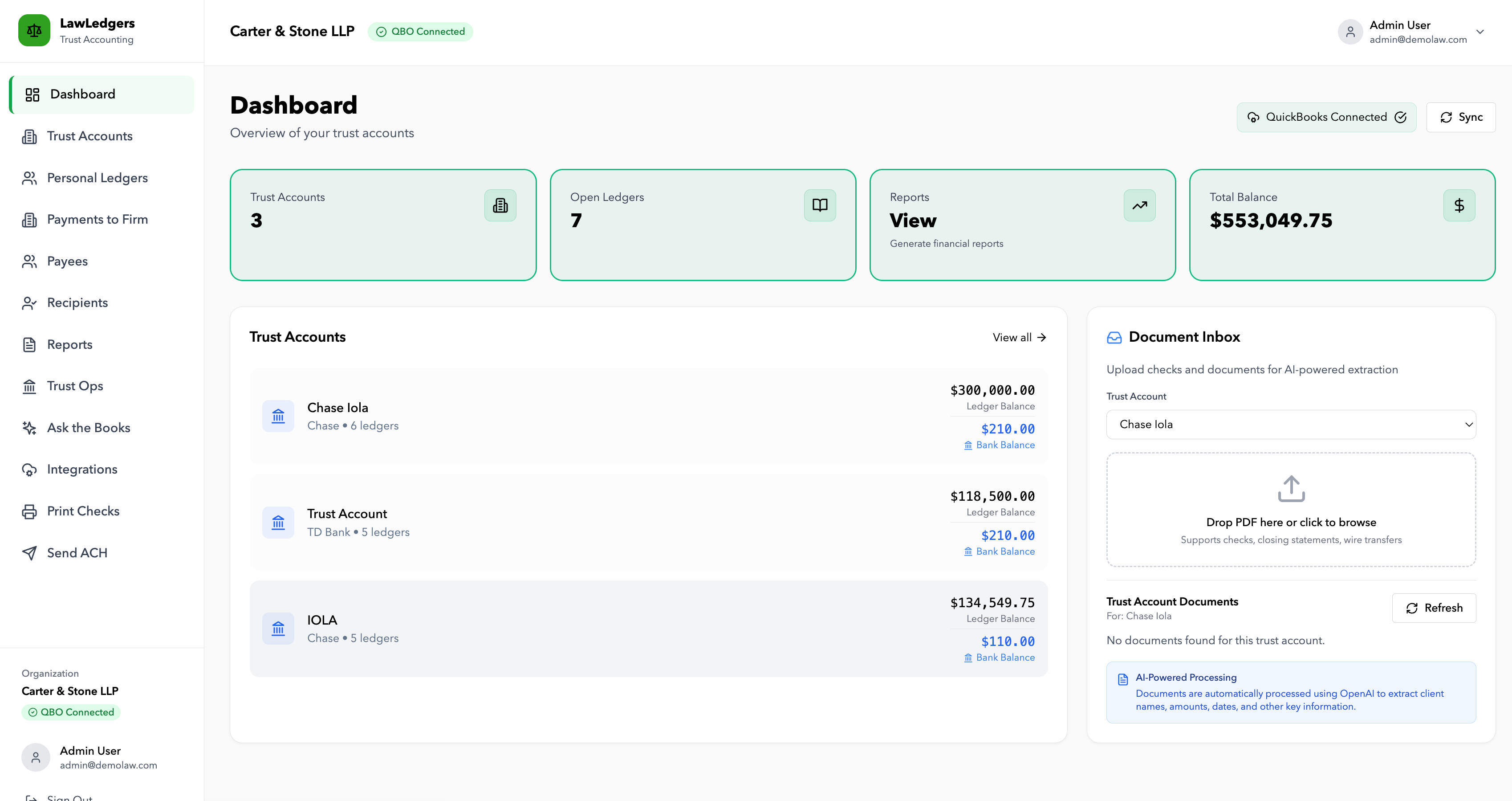
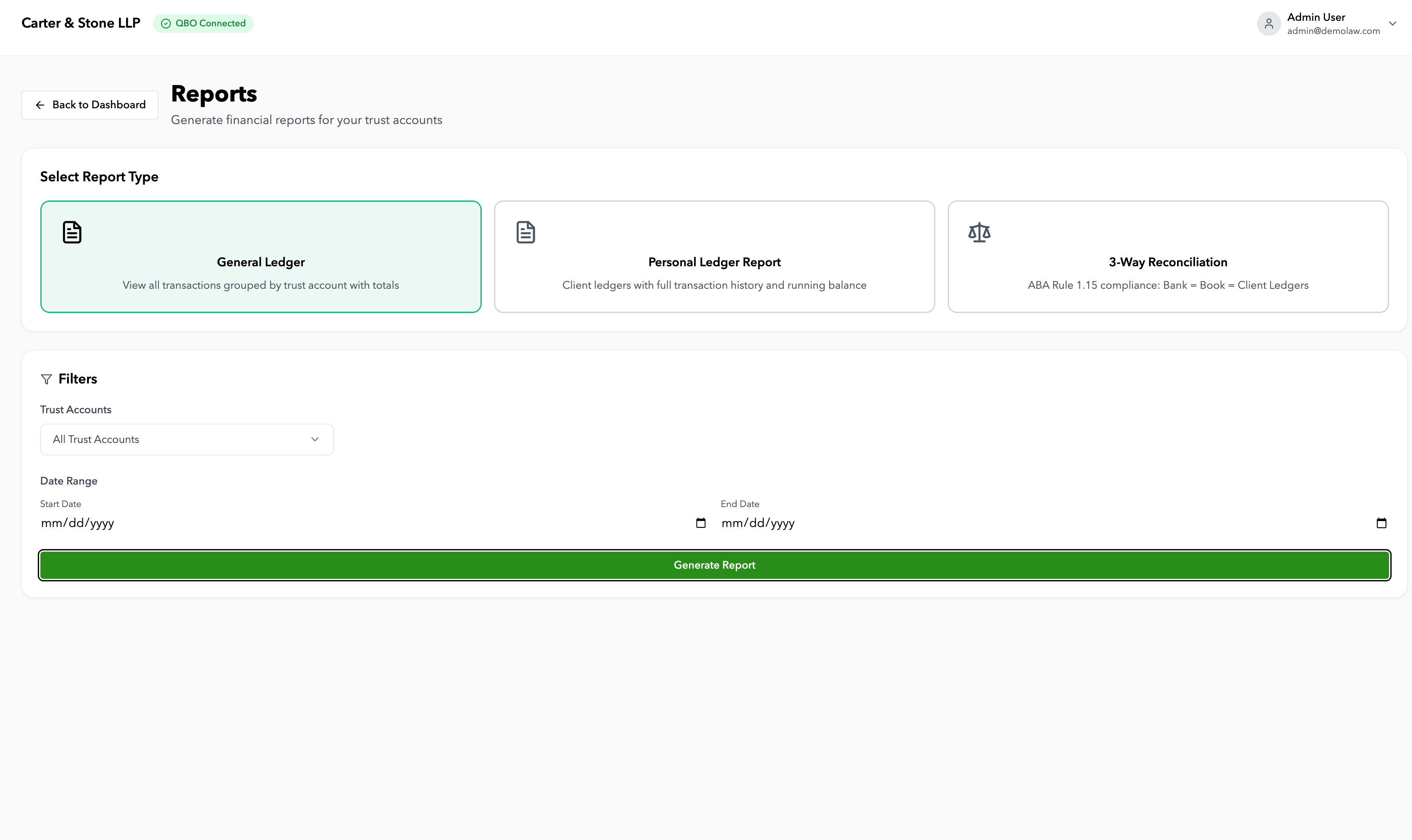
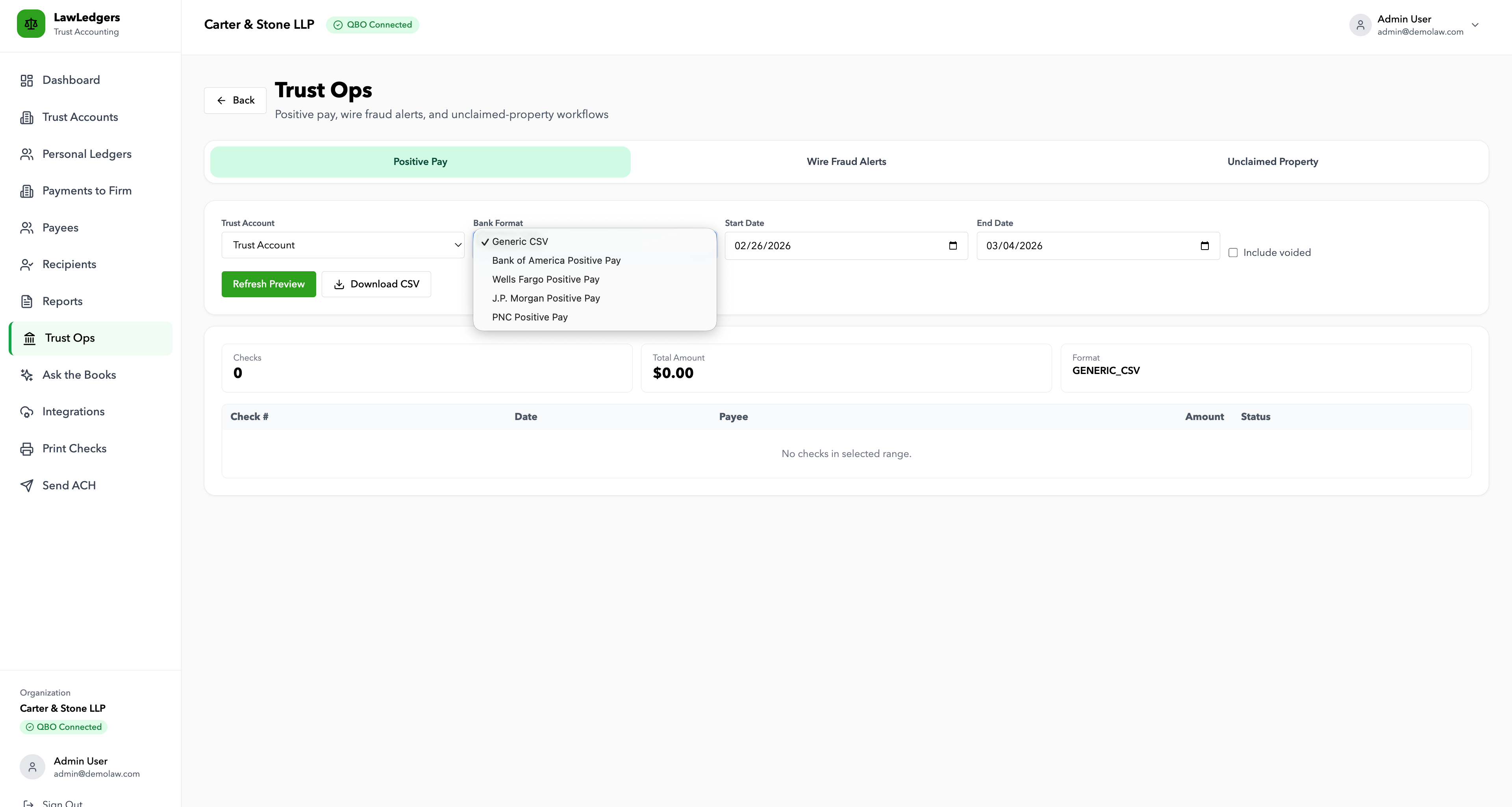
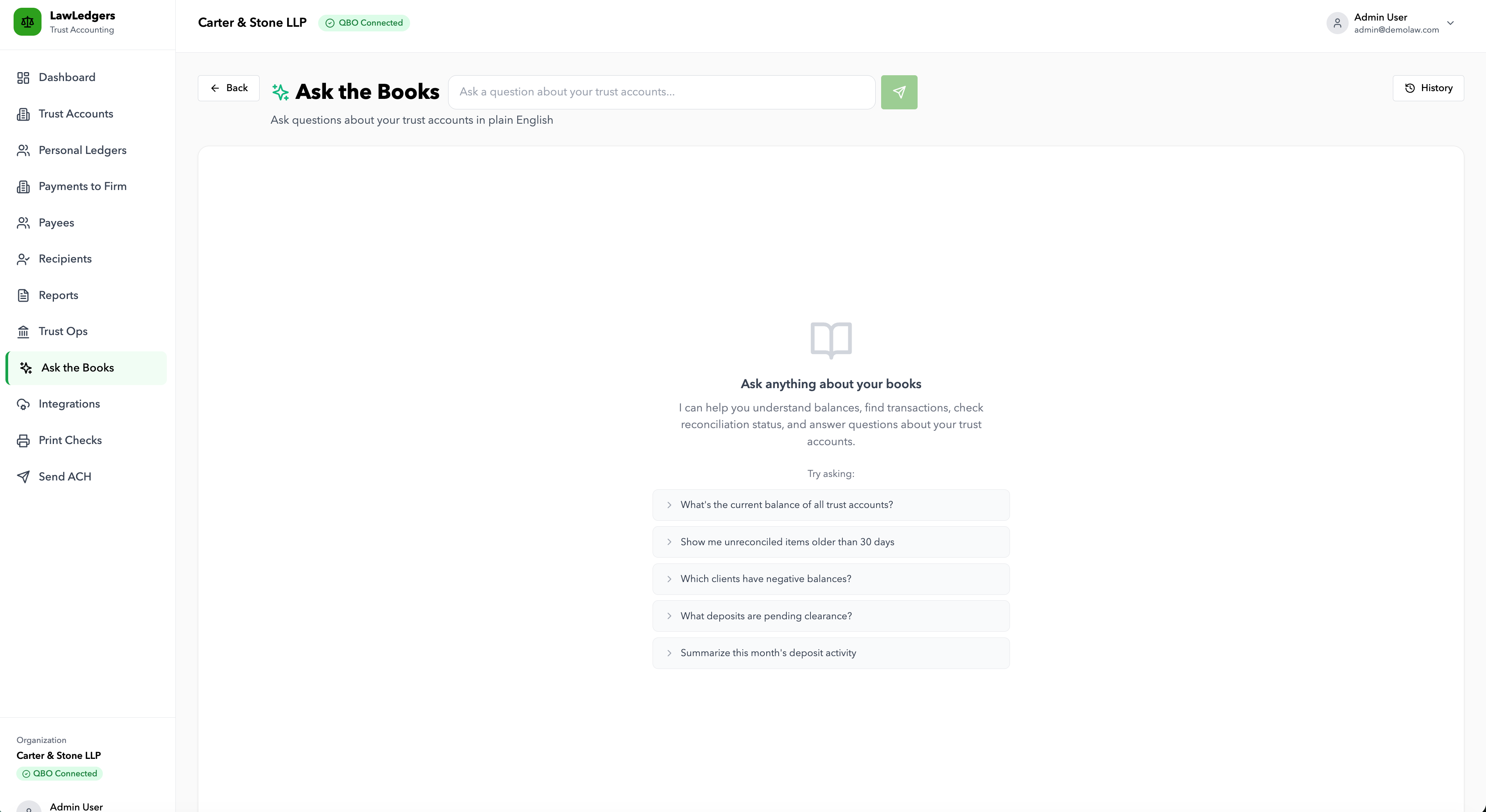
LawLedgers creates operational value across leadership, accounting, and operations teams without adding process complexity.
Higher confidence in trust-account controls and partner oversight. Faster visibility into balances, risk points, and exceptions. Stronger readiness for review and compliance discussions.
Reduced manual reconciliation and spreadsheet rework. Clear matter-level attribution and transaction history. More consistent month-end workflows and documentation.
Standardized workflows across teams and trust accounts. Cleaner integrations with finance and matter systems. Better scalability without multiplying control risk.
Trust accounting stays accurate while finance and matter workflows stay aligned.
Keep accounting records aligned with operational trust activity. Reduces duplicate entry between trust operations and accounting systems, improves consistency for close, review, and reporting workflows, and supports cleaner collaboration between operations staff and external accountants.
Connect trust records with real bank activity. Support transaction matching with real bank-feed context, strengthen cleared-date workflows and reconciliation quality, and reduce statement-driven manual processing overhead. Near-real-time bank signals as part of daily trust operations.
OCR and structured extraction for trust-account document workflows. Transforms PDFs into structured inputs for operational trust workflows, reduces manual transcription and associated error exposure, and improves source-to-ledger traceability for review and audit support.
Organization-scoped models and enforcement patterns help prevent cross-firm data leakage. Every record carries the organizational context required to keep it strictly scoped to the owning firm.
Production posture includes controlled infrastructure access, secrets management, encryption, and audit logging patterns designed for financial-legal sensitivity.
It is trust-accounting compliance infrastructure engineered for law firms that must handle client funds with precision, consistency, and defensible controls. Bank-connected workflows, matter-level attribution, segmented ledger enforcement, and immutable event history prevent common trust-accounting failure points before they become regulatory issues.
Instead of fragmented spreadsheets and manual cross-checking, firms gain a structured operating model for deposits, disbursements, reconciliation, and reporting. Every step is easier to verify, every correction easier to explain, and every review cycle easier to manage.
Law firms are increasingly evaluated not just on outcomes, but on whether their workflows are consistently defensible.
Public reporting has shown meaningful growth in trust-account-related client-protection reimbursements in New York — in both award volume and total dollars reimbursed.
Across jurisdictions, random-audit programs are increasingly cited as effective for identifying noncompliance early, improving attorney education, and reducing avoidable trust-account failures.
Escrow-heavy and settlement-heavy practices continue to face outsized control risk, making matter-level attribution, clear review trails, and reliable reconciliation workflows essential.
Trend cues drawn from public commentary on attorney trust-account oversight, including New York City Bar materials on random-audit efficacy and New York client-protection fund patterns. Reference →
No. LawLedgers is designed to strengthen trust-accounting operations and controls while working alongside your existing accounting and tax relationships.
Yes. Most firms stage migration by account or workflow, validate balances, and move into controlled usage with minimal operational interruption.
Yes. Parallel periods are common for trust workflows so teams can compare outputs, verify reconciliation, and cut over with confidence.
Teams usually onboard fastest when the system is configured around their existing matter and trust processes, with role-specific training for operations and bookkeeping staff.
Yes. The compliance framework includes monthly trust account reconciliations with three-way reconciliation reports, annual trust account certification preparation, compliance monitoring for RPC 1.15, escheatment compliance for unclaimed client funds, and readiness for random Attorney Grievance Committee audits.
Yes. LawLedgers supports bank-connected workflows for matching, cleared-date operations, and reconciliation support via Plaid integration.
Use the Request Trial button or email staff@lawledgers.com directly with the subject line "Request LawLedgers Trial." A member of our team will follow up within one business day.
Request a LawLedgers trial and evaluate bank-connected trust workflows built for legal compliance operations.
LawLedgers · 2333 56th Drive, Brooklyn, NY 11234 · New York trust-accounting software and services for law firms · Patent-pending technology